
Press
Wave Riders
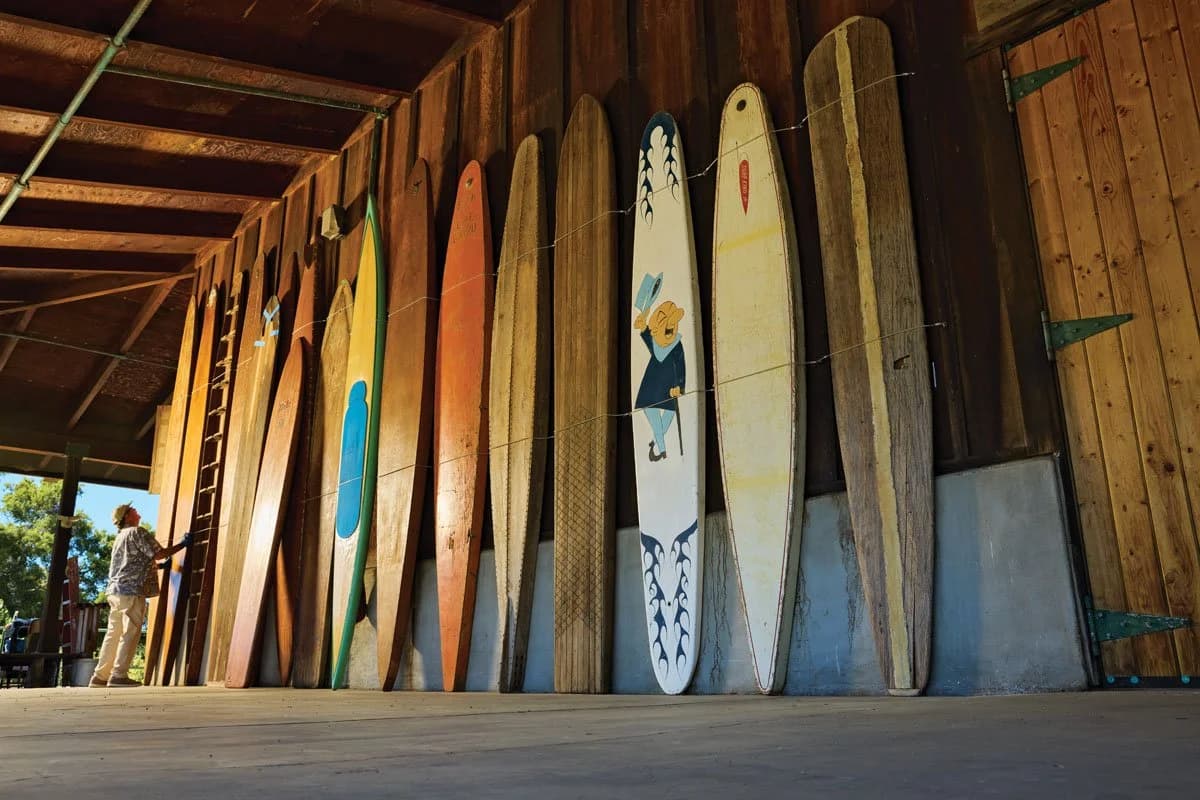
Wayne Babcock has hundreds of surfboards in his collection representing the span of design evolution, from the earliest Hawaiian alaias to today's high-performance boards.
Written by Christian Beamish · Photographs by Dewey Nicks
Wayne Babcock has hundreds of surfboards in his collection representing the span of design evolution, from the earliest Hawaiian alaias to today's high-performance boards. Outside his storage and display space on a ranch in Carpinteria, he keeps an array of early 20th-century boards called kook-boxes, designed by surfer Tom Blake and inspired by ancient olos, the 14- to 16-foot solid koa-wood surfboards of Hawaiian royalty.
Surfboards embody the cultural mores of their time; the chemical composites of today no less than the great olos of Hawaiian chieftains, selected from sacred forests. But what thread links the cultures of the Polynesian voyagers and the surfers of today? As the holder of one of the preeminent collections of surfboards — a grouping that includes boards that date to Hawaiian royalty and contemporary world champions — Wayne Babcock is uniquely positioned to answer that question. "It's all connected," he says, by "the same beautiful act of riding a wave and playing in nature."


Born in Los Angeles in 1958, Babcock describes his childhood wonderment at the butterflies and flowers that, for him, represented the real magic of the universe. This notion of magic, or at least of a grander scheme at work, continues to inform his view of the world. "It's funny how the universe works with me," he says. The historic surfboards that are his passion seem to come to him, he adds. "They manifest."
Babcock's long-running connection to Carpinteria includes a deep appreciation for the Channel Islands surfboard label, started by Al Merrick in Santa Barbara in the 1970s.
“Surf aficionados and collectors are a rare breed. Probably the most knowledgeable and prolific collector is Wayne Babcock. He has, arguably, the best collection in the U.S., if not the world.”
Randy Rarick, who runs classic surfboard auctions and does restoration work on boards, says Babcock stands apart from the field. But it's not as though Babcock sits around waiting for the boards to manifest. He's been a collector for a long time. His mother was a collector, and when he was young she took him to estate sales around Los Angeles, helping him develop an eye for the valuable and unusual. Babcock held a spot at the Rose Bowl Flea Market for years, adding to his trove of 20th-century ephemera, such as sunglasses, lighters, and pocket knives.
The surfboards are his heart's delight, but Babcock pays the bills running Angels Antiques in Carpinteria, where for 40 years he has been the go-to guy for anyone looking for that special midcentury object — a chair, table, teapot, or tchotchke. Hawaiiana is another specialty; he has an encyclopedic knowledge of Hawaiian slack-key guitar players.



In his flea market days, Babcock displayed a placard designed like a wanted poster from the Wild West. But instead of desperados, he was after vintage surfboards: "Top dollar paid!" read a graphic explosion. Rather than provide contact information on the poster, he waited for people to talk with him directly so he could gauge whether a lead was worth following.
The older boards in the collection speak of summers long passed yet suggest the timeless joy of getting into the surf and simply riding back to shore. George Greenough, originally of Montecito but long ensconced among the glistening forests and point surf of Byron Bay in New South Wales, Australia, is surfing's patron saint of high-performance design. His experiments with kneeboards led to the shortboard revolution in 1967, forever altering the way surfers approach the waves.


During one such conversation, a woman mentioned that her husband had a very old board. So began a series of phone calls that Babcock likens to an affair, in which she quietly kept him apprised of her spouse's willingness to let the board go. Her husband had bought it from another Angeleno who had acquired the board in the 1930s in Waikiki, the cradle of contemporary surfing. Waikiki was the stomping grounds of a cadre of Hawaiian watermen known as the Beach Boys, among them the greatest of all surfers, Duke Kahanamoku.
It was not Duke's board, but the man in the 1930s had asked the Beach Boys — whom he presumably met through surf lessons — if he could buy the oldest surfboard they knew of. And it is the thought of distant generations of Hawaiian grandfathers riding this surfboard that fires Babcock's imagination.


His oldest boards were shaped by master crafters who obtained the characteristics they wanted in their designs through concaves and chines, well-shaped rails, and pure, functional outlines. Ultimately, perhaps, it is the refinement of these earliest boards that connects the surfing and seafaring technologies of ancient Polynesia to those of the modern era.
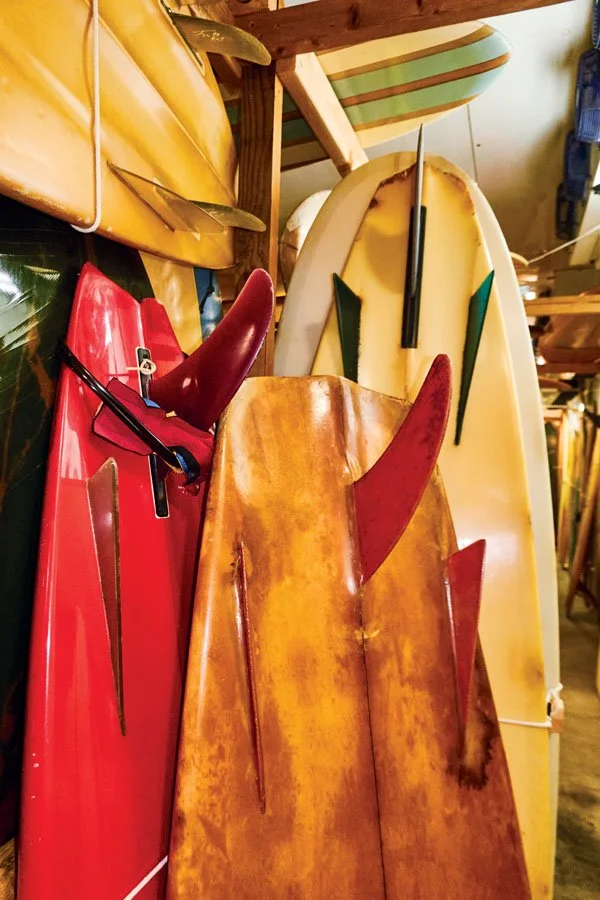
Babcock's collection comprises some 400 surfboards, many representing important shaping developments: Joe Quigg's Malibu Chip design sits on a rack above a Bob Simmons planing hull; there are Renny Yater's era-defining noseriders and his California guns of the 1970s. Dick Brewer big-wave spears share space with George Greenough's high-speed windsurfing boards. Al Merrick's shortboard precision and John Bradbury single fins attest to the lineage of Santa Barbara surfing.
"Carpinteria needs a surf museum," Babcock says. His wave-riding talismans, though well-catalogued and properly stored in a temperature-controlled container on a private ranch in Carpinteria, are not available for public viewing. He envisions a venue where these boards can inform, inspire, and help people connect to the splendor of surfing and its long history in the Pacific and around the world.
Originally published in
Santa Barbara Magazine
August 2024